


Fully compliant. Funds settle into your Client Account without delay, strictly adhering to MEAS Standard 9.
Funds are never commingled. They are processed securely by CHIP and reconciled into your account by the next business day.


Zero transaction fees. Buyers pay the exact deposit amount, and agencies pay nothing to receive it.
We partner with Bank Negara registered payment gateway (CHIP IN Sdn Bhd) to ensure competitive rates, rapid settlement times, and direct local support.


Agencies are reporting institutions. We automate your specific compliance obligations under the AMLA 2001 Act.
Streamlined process. You only need to upload the OTP/OTR to link the deposit; no duplicate document uploads required.

Your commissions are untouched. We monetise downstream valuation leads via ValuationXchange and bank partners.
You stay in control. We identify risks, but your agency decides whether to proceed or refund based on your internal SOPs.


Audit-ready clarity. Bank statements clearly show "CHIP" transfers, supported by downloadable reconciliation reports.
FPX is standard. Credit card payment options for international clients are scheduled for release in Q1 2026.

Be part of the movement for transparent,
tech-enabled valuation in Malaysia.



Johor’s property market is moving faster than it has in years.
Infrastructure optimism, cross-border demand and renewed buyer confidence are compressing transaction timelines, increasing application volumes and placing new pressure on bank credit and risk teams.
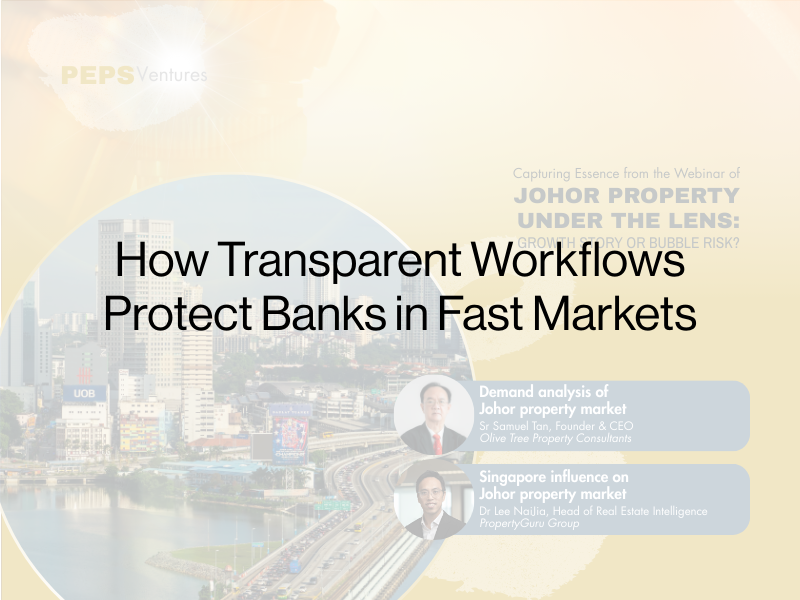
These dynamics were explored during the Johor Property Under the Lens webinar, hosted by PEPS Ventures, where industry leaders shared perspectives on Johor’s growth trajectory and the implications for valuation and lending. One message emerged clearly from the session: in fast-moving markets, a bank’s greatest vulnerability is not speed, but understanding the actual value of the property being financed.
For lenders, that vulnerability is amplified when information flows between agents, valuers and banks remain fragmented.
As highlighted during the webinar, Johor’s price movements are uneven. Certain corridors have seen sharp uplifts driven by infrastructure and cross-border interest, while others continue to carry legacy overhang. In high-velocity pockets, expectations around valuation turnaround shorten, indicative values circulate earlier, and deal momentum builds quickly.
In these conditions, credit risk is often shaped upstream, well before a loan reaches the credit committee.
Manual workflows depend heavily on phone calls, emails and messaging apps to convey instructions, updates and clarifications. While efficient, these channels are unstructured and difficult to trace. When assumptions, instructions or timelines differ across parties, banks are left managing exposure with incomplete context.
This creates challenges not in valuation quality itself, but in demonstrating how conclusions were reached, especially under audit or post-approval review.
A recurring insight from the webinar was the growing gap between market expectations and fundamentals. Indicative values are often shared early to guide buyers and agents, but they are not substitutes for full valuation exercises that assess physical condition, legal compliance, incentives and long-term sustainability.
From a bank’s perspective, risk arises when early indications begin to anchor credit expectations, particularly in competitive lending environments. Without a structured record of how those early figures evolved into final valuation outcomes, credit teams may later struggle to evidence decision integrity.
Here, transparent workflows play a constructive role. They provide clarity, continuity and shared understanding across the valuation journey, ensuring that every step from instruction to final report is visible and properly contextualised.
Fast markets also magnify operational and compliance risk. When valuation instructions, clarifications and revisions are scattered across multiple communication channels, banks face difficulty in:
In Johor’s context, where pricing signals can shift quickly across locations and asset types, governance gaps translate directly into credit risk exposure.

The webinar reinforced an important reality: sustainable growth requires not just demand, but discipline. For banks, that discipline increasingly depends on transparent, auditable interaction flows that support professional judgement rather than constrain it. Transparent workflows enable credit teams to work with greater confidence by providing:
In a market like Johor, where momentum can shift rapidly, clarity allows speed to remain responsible.
Johor’s growth story remains compelling, but it also offers a timely lesson. As transaction volumes rise, banks that rely solely on manual coordination risk inheriting blind spots that only surface under stress.
The perspectives shared during the webinar point to a clear conclusion: credit resilience in fast markets is built on transparency and shared understanding.
Banks that invest in structured interaction workflows, strengthen communication governance and maintain audit-ready clarity will be better positioned to support growth while protecting portfolio quality.
In property lending, the strongest safeguard is not prediction, but evidence.


Ready to Elevate Trust in Property Valuation?Join the #TransformationTribe and discover how ValuationXchange empowers smarter lending through trusted, tamper-proof, and transparent valuation workflows.
Reach out to our team to explore how we can support your valuation, compliance, or risk management transformation.