

Fully compliant. Funds settle into your Client Account without delay, strictly adhering to MEAS Standard 9.
Funds are never commingled. They are processed securely by CHIP and reconciled into your account by the next business day.


Zero transaction fees. Buyers pay the exact deposit amount, and agencies pay nothing to receive it.
We partner with Bank Negara registered payment gateway (CHIP IN Sdn Bhd) to ensure competitive rates, rapid settlement times, and direct local support.


Agencies are reporting institutions. We automate your specific compliance obligations under the AMLA 2001 Act.
Streamlined process. You only need to upload the OTP/OTR to link the deposit; no duplicate document uploads required.

Your commissions are untouched. We monetise downstream valuation leads via ValuationXchange and bank partners.
You stay in control. We identify risks, but your agency decides whether to proceed or refund based on your internal SOPs.


Audit-ready clarity. Bank statements clearly show "CHIP" transfers, supported by downloadable reconciliation reports.
FPX is standard. Credit card payment options for international clients are scheduled for release in Q1 2026.

Be part of the movement for transparent,
tech-enabled valuation in Malaysia.



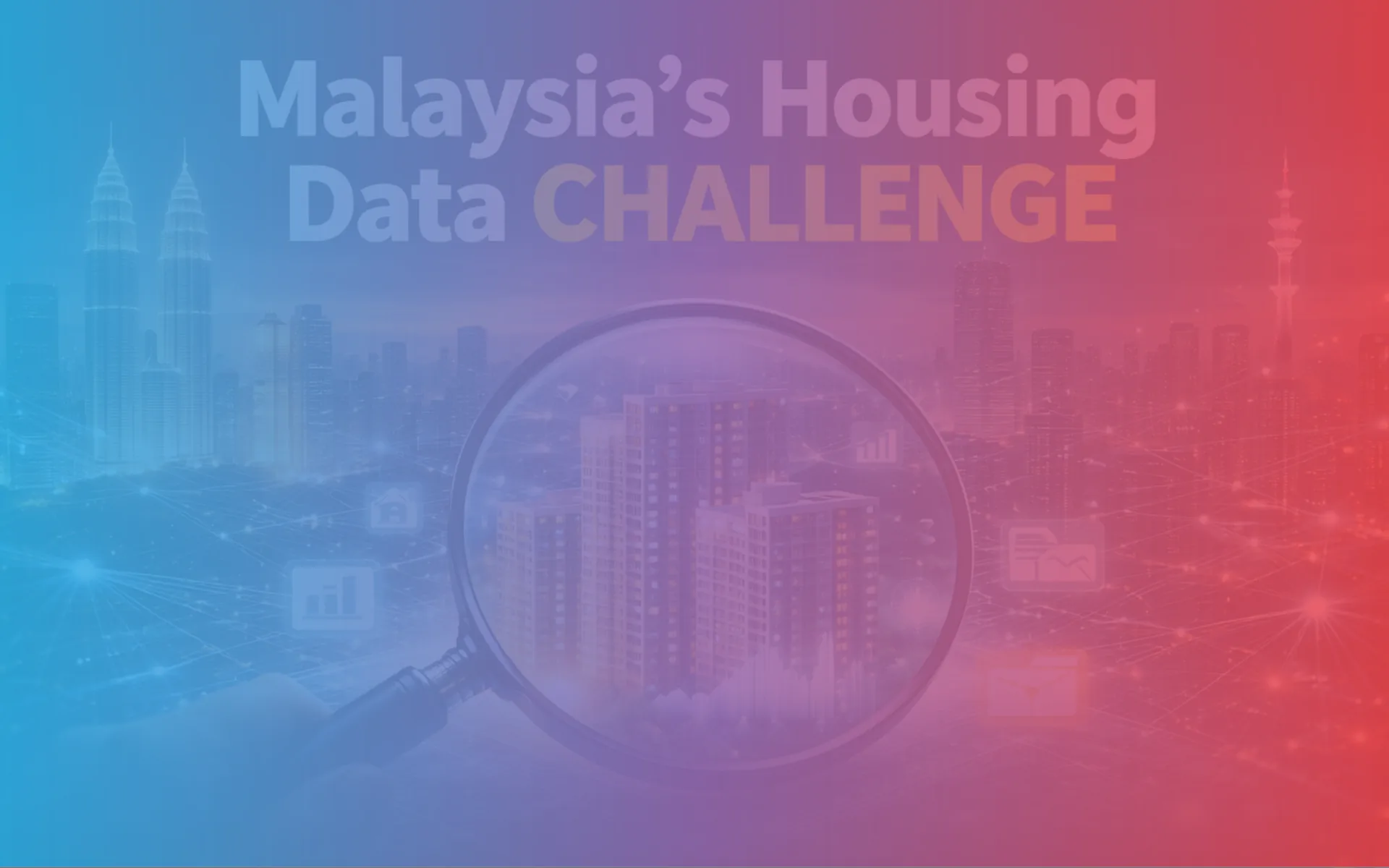
There’s been no shortage of discussion around housing affordability in Malaysia. Prices, income gaps, supply mismatches—it’s all been covered, debated, and revisited.
So when Housing and Local Government Minister Nga Kor Ming recently spoke about moving towards a more data-driven approach, as reported by EdgeProp, it didn’t feel like a new direction. If anything, it felt like a recognition of something the industry has already known for some time.

The challenge has never really been the absence of data.
It’s what happens to that data after it’s created.
Because across the property ecosystem, information is constantly moving. Transactions are logged. Valuations are completed. Reports are submitted. On paper, there’s plenty to work with.
But step back slightly, and a different picture starts to emerge.
The same property can carry different signals depending on where you look.
Valuation outcomes are sound within their own context, but harder to line up across cases.
Data exists - but rarely in a way that allows it to be read together.
So decisions continue to be made. Just not always with the full picture in view.
That’s where the idea of a “data-driven ecosystem” starts to feel less like a policy direction, and more like an operational question.
Not how much data is available - but whether it can actually move, connect, and be understood beyond a single transaction.
Valuations sit right in the middle of this.
They influence lending. They anchor pricing expectations. They quietly shape how risk is perceived across the market. And yet, much of that insight remains contained within individual workflows - useful in the moment, but rarely carried forward in a way that builds broader clarity.
Which is why simply calling for more data doesn’t quite address the issue.
What changes things is structure.
When valuation data is captured consistently, shared through connected systems, and preserved with a clear audit trail, it begins to behave differently. Patterns become easier to spot. Comparisons start to hold. Confidence builds - not from volume, but from coherence.
This is the layer that often goes unnoticed.
Not the data itself, but the way it is handled.
Platforms like ValuationXchange are beginning to sit within that space - not by introducing new data into the ecosystem, but by changing how existing data is captured and flows between stakeholders.
Banks and valuers operate within a shared environment. Outputs become more standardised. Each step leaves a trace that can be followed.
Nothing about the role changes dramatically. But the visibility does.
And with that, the usefulness of the data begins to shift.
Because a data-driven market isn’t defined by how much information it produces. It’s defined by how clearly that information can be read - across transactions, across institutions, and over time.
Malaysia’s move towards more targeted housing policies suggests a desire for that kind of clarity.
Whether it can be achieved may depend less on new initiatives, and more on whether the underlying data is allowed to connect in the first place.
And in that sense, the question isn’t whether the data exists.
It’s whether we’re finally able to see it for what it is.
The data is already there. The question is whether it’s being seen clearly.If you’re looking to bring that clarity into your valuation workflows, reach out to us to explore how ValuationXchange can support your firm.


Ready to Elevate Trust in Property Valuation?Join the #TransformationTribe and discover how ValuationXchange empowers smarter lending through trusted, tamper-proof, and transparent valuation workflows.
Reach out to our team to explore how we can support your valuation, compliance, or risk management transformation.